Welcome to BEE 4850/5850!
Lecture 01
January 21, 2026
Course Introduction
About Me
Instructor: Prof. Vivek Srikrishnan,
Research Interests:
- Bridging Earth science, data science, and decision science to improve climate risk management;
- Unintended consequences which result from neglecting uncertainty or system dynamics.
Meet My Supervisors
TA
TA:
Research Interests: Electric power systems
Other Interests: Hiking in national parks, scuba diving, reading non fiction and sci-fi, learning local cuisines and history while traveling, and cooking
What Do You Hope To Get Out Of This Course?
Take a moment, write it down, and we’ll share!
What We Are Doing This Semester?
Why Does Data Analysis Matter?
- Scientific insight;
- Decision-making;
- Understanding uncertainty
Examples of Data-Related Questions
- How often will a particular (usually extreme) outcome occur?
- What causes differences between environmental conditions at different times/locations?
- What might the impacts be of environmental change?
- Does a new (treatment/management) method have a reliable impact?
The Ideal
Goal: Obtain data that is so self-evident that you don’t need to do statistics!
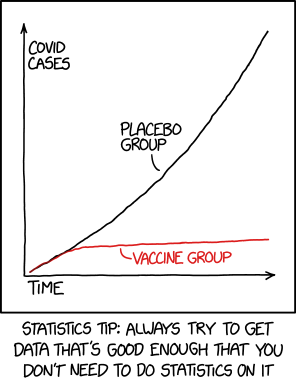
Source: XKCD 2400
But in Actuality
- Except in the most controlled experiments, data are noisy;
- The causes of the data cannot be extracted from the data alone;
- The reasons for statistical analyses are not found in the data themselves.
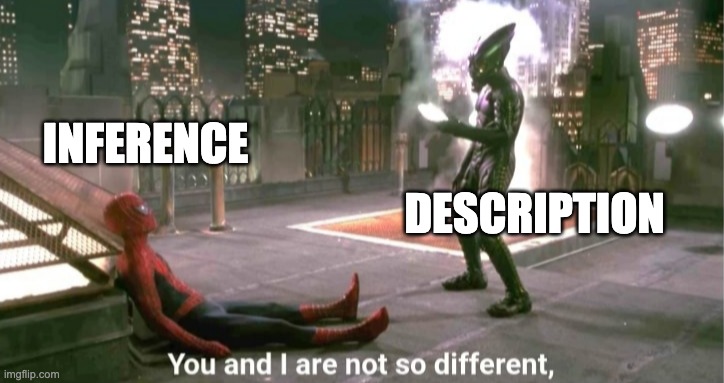
Description and Inference are Connected
Except for superficial tasks:
- Knowing what is important to describe requires a model;
- Understanding how the data might differ from the population requires a model.
Some Problems With The “Standard” Data Analysis Toolkit
- Statistical assumptions may not be valid;
- “Null” vs “Alternative” hypotheses and tests may be chosen for computational convenience, not scientific relevance.
- Many different substantive models can imply the same statistical model.
Important: “Big” data doesn’t solve the problem!
Model-Based Data Analysis
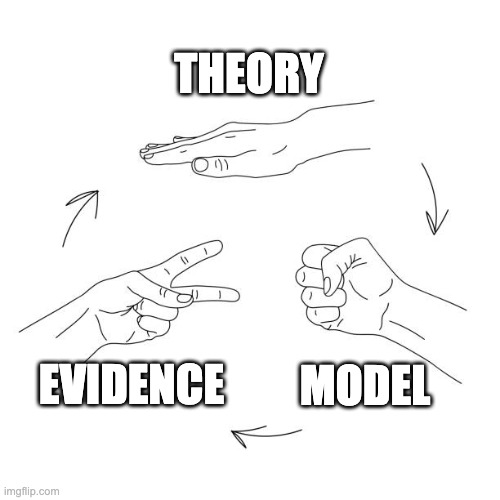
Models are how we assess evidence for theories.
Models are encodings of hypothesized data-generating processes.
What Can We Do With Models?
- Inference: what are parameter values which explain data?
- Simulation: what are alternative counterfactual observations?
- Projection: what future data might be observed assuming this data-generating process?
- Testing: which data-generating processes are most consistent with the data?
My Philosophical Position
- Statistics is a rhetorical tool: we use stats to tell a quantitative story about data.
- Probability theory helps us deduce logical implications of theories conditional on our assumptions
- Cannot use an “objective” procedure to avoid subjective responsibility
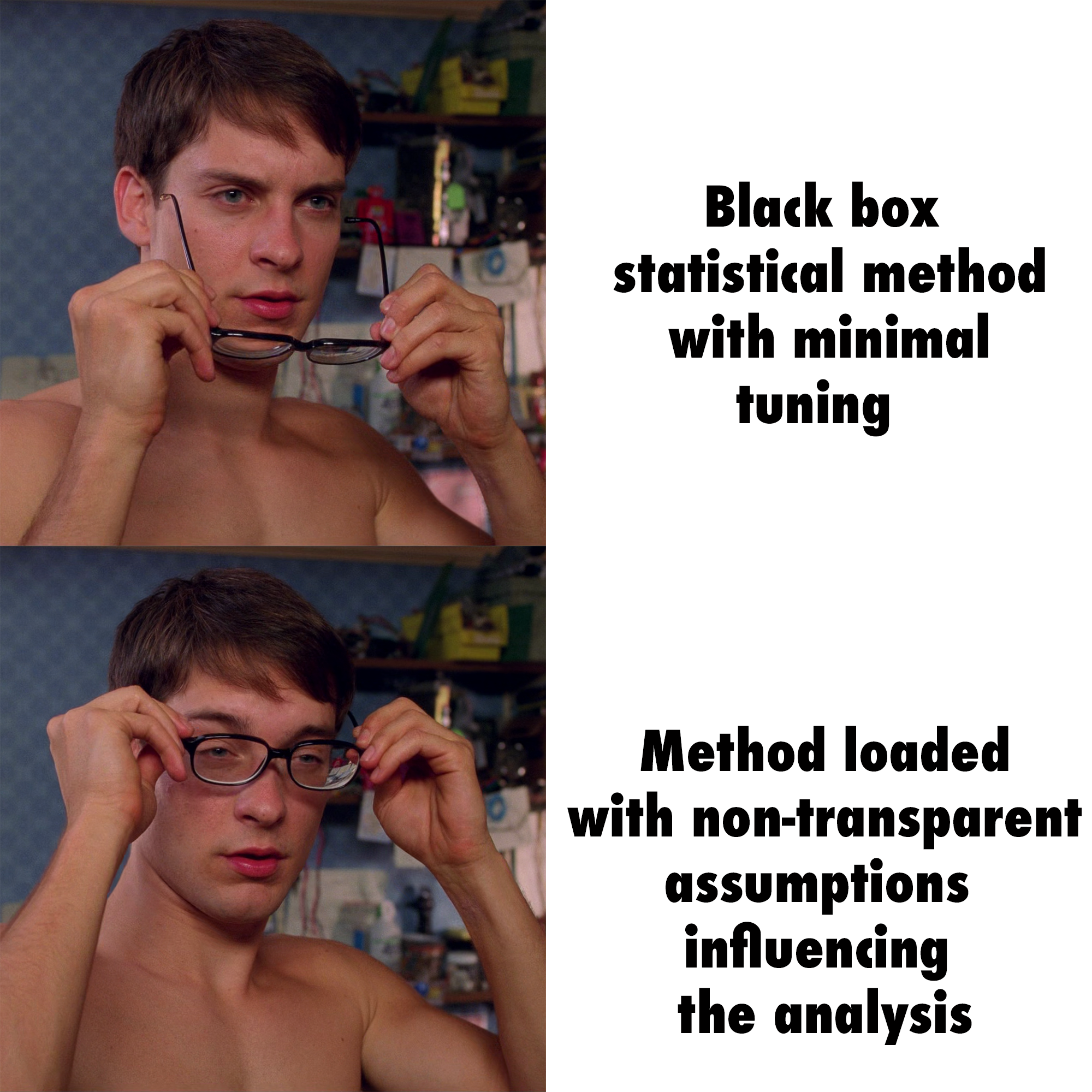
Model-Based Data Analysis
We can (transparently):
- Examine logical implications of model assumptions (including interventions/out-of-sample generation).
- Assess evidence for multiple hypotheses by generating simulated data.
- Identify opportunities to design future experiments or observations to distinguish between competing hypotheses.
Model-Based Data Analysis
Models are how we assess evidence for theories.
What We Will Cover
- Exploratory Analysis
- Linear Models and GLMs
- Model Calibration, Evaluation, and Comparison
- Simulation (Monte Carlo, Bootstrap, Imputation)
- Extreme Value Analysis
Course Policies
Background Knowledge: Computing
- Basics (at the level of CS 111x)
- No specific language requirement.
- Some extra work/effort may be needed if you haven’t coded in a while.
- May need some additional familiarity with statistical packages (and “light” optimization)
Background Knowledge: Probability/Statistics
- ENGRD 2700/CEE 3040
- Summary statistics of data
- Probability distributions
- Basic visualizations
- Monte Carlo basics
Grades
| Assessment | Weight |
|---|---|
| Exercises | 5% |
| Quizzes | 25% |
| Readings | 10% |
| Homework Assignments | 30% |
| Term Project | 30% |
Overall Guidelines
- Collaboration highly encouraged, but all work must reflect your own understanding
- Submit PDFs on Gradescope
- 50% penalty for late submission (up to 24 hours)
- Standard rubric available on website
- Always cite external references
Exercises
- On Gradescope
- Simple, mostly multiple choice problems, autograded
- Can submit as often as you want, intended to reinforce concepts.
Quizzes
- 5 throughout the semester
- Beginning of a Friday class, end of class will motivate/introduce new material.
- Closed book, closed note, no calculators.
- Will be scanned into Gradescope for grading/returns.
Readings
- Several readings assigned for discussion throughout the semester.
- Annotation assignments on Canvas through Perusall: by start of next Monday’s lecture.
- Annotations can discuss aspects of the reading you think are interesting, had questions on, or can engage with other students’ annotations.
- Will be graded on level of engagement, not quantity of annotations.
Literature Critique
- For 5850 students
- Select a paper which involves some type of statistical or data analysis
- Critique choices: do they support the scientific conclusions?
- Submit a 2-3 page writeup at the end of the semester
- If you’re unsure where to look for a paper, talk to Prof. Srikrishnan
Homework Assignments
- More in-depth problems, mostly computational
- Roughly 2 weeks to complete
- Regrade requests must be made within one week
Term Project
- Analyze a question of interest using a data set of your choosing
- Can work individually or groups of 2
- Proposal due in March, interim update in April, final report during finals week.
Attendance
Not required, but students tend to do better when they’re actively engaged in class.
Office Hours
- Instructor: MWTh 10-11 AM, 318 Riley-Robb
- TA: TBD
- Almost impossible to find a time that works for all (or even most); please feel free to make appointments as/if needed. Usually also have time after class (perhaps not all Mondays).
Accomodations
If you have any access barriers in this class, please seek out any helpful accomodations.
- Get an SDS letter.
- If you need an accomodation before you have an official letter, please reach out to me ASAP!
Academic Integrity
Hopefully not a concern…
- Collaboration is great and is encouraged!
- Knowing how to find and use helpful resources is a skill we want to develop.
- Don’t just copy…learn from others and give credit.
- Submit your own original work.
Academic Integrity
Obviously, just copying down answers from Chegg or ChatGPT and passing them off as your own is not ok.
LLMs: Bullshit Generators
Think about ChatGPT as a drunk who tells stories for drinks.
It will give you plausible-looking text or code on any topic, but it doesn’t know anything beyond what it “overheard.”
ChatGPT can be useful for certain tasks (e.g. understanding code errors), but may neglect context for why/when certain information or solutions work.
ChatGPT: The Stochastic Parrot
Must specifically call out where you used ChatGPT in your work (beyond simple referencing; see syllabus for details).
Class Tools
Communications
Use Ed Discussion for questions and discussions about class, homework assignments, etc.
- Try to use public posts so others can benefit from questions and can weigh in.
- I will make announcements through Ed.
When urgency or privacy is required, email is ok.
Important
Please include BEE4850 in your email subject line! This will ensure it doesn’t get lost in the shuffle.
Better: Use Ed Discussion and reserve email for matters that are particular urgent and/or require privacy.
Course Website
https://envdata.viveks.me/spring2026/
- Central hub for information, schedule, and policies
- Will add link and some information to Canvas (assignment due dates, etc)
Computing Tools
- Course is programming language-agnostic.
- Assignments will have notebooks set up for Julia (environments, etc) on GitHub.
Some Tips For Success
- Start the homeworks early; this gives time to sort out conceptual problems and debug.
- Ask questions (in class and online) and try to help each other.
- Give me feedback!
Upcoming Schedule
Next Classes
Friday: Probability Review
Next Week: Exploratory analysis and visualization.
Assessments
Homework 1 available; due Friday, 2/6.