Probability Review


Lecture 02

January 23, 2026

Review

Last Class

  • Class Motivation
  • Policies (see syllabus if class missed)

Probability “Review”

What is Uncertainty?

…A departure from the (unachievable) ideal of complete determinism…

Walker et al. (2003)

Types of Uncertainty

Uncertainty Type Source Example(s)
Aleatory uncertainty Randomness Dice rolls, Instrument imprecision
Epistemic uncertainty Lack of knowledge Climate sensitivity, Premier League champion

Which Uncertainty Type Meme

Sources of Uncertainty

  • Model structures
  • Parameters
  • Data collection (measurement/observation errors)

Probability

Probability is a language for expressing uncertainty.

The axioms of probability are straightforward:

  1. \(\mathcal{P}(E) \geq 0\);
  2. \(\mathcal{P}(\Omega) = 1\);
  3. \(\mathcal{P}(\cup_{i=1}^\infty E_i) = \sum_{i=1}^\infty \mathcal{P}(E_i)\) for disjoint \(E_i\).

Probability Distributions

Distributions are mathematical representations of probabilities over a range of possible outcomes.

\[x \to \mathbb{P}_{\color{green}\mathcal{D}}[x] = p_{\color{green}\mathcal{D}}\left(x | {\color{purple}\theta}\right)\]

  • \({\color{green}\mathcal{D}}\): probability distribution (often implicit);
  • \({\color{purple}\theta}\): distribution parameters

Sampling Notation

To write \(x\) is sampled from \(\mathcal{D}(\theta)\): \[x \sim \mathcal{D}(\theta)\]

For example, for a normal distribution: \[x \overset{\text{i.i.d.}}{\sim} \mathcal{N}(\mu, \sigma)\]

Probability Density Function

A continuous distribution \(\mathcal{D}\) has a probability density function (PDF) \(f_\mathcal{D}(x) = p(x | \theta)\).

The probability of \(x\) occurring in an interval \((a, b)\) is \[\mathbb{P}[a \leq x \leq b] = \int_a^b f_\mathcal{D}(x)dx.\]

Important: \(\mathbb{P}(x = x^*)\) is zero!

Probability Mass Functions

Discrete distributions have probability mass functions (PMFs) which are defined at point values, e.g. \(p(x = x^*) \neq 0\).

Cumulative Density Functions

If \(\mathcal{D}\) is a distribution with PDF \(f_\mathcal{D}(x)\), the cumulative density function (CDF) of \(\mathcal{D}\) is \(F_\mathcal{D}(x)\):

\[F_\mathcal{D}(x) = \int_{-\infty}^x f_\mathcal{D}(u)du.\]

(a) Relationship of CDF and PDF
(b)
Figure 1

Relationship Between PDFs and CDFs

Since \[F_\mathcal{D}(x) = \int_{-\infty}^x f_\mathcal{D}(u)du,\]

if \(f_\mathcal{D}\) is continuous at \(x\), the Fundamental Theorem of Calculus gives: \[f_\mathcal{D}(x) = \frac{d}{dx}F_\mathcal{D}(x).\]

Quantiles

The quantile function is the inverse of the CDF:

\[q(\alpha) = F^{-1}_\mathcal{D}(\alpha)\]

So \[x_0 = q(\alpha) \iff \mathbb{P}_\mathcal{D}(X < x_0) = \alpha.\]

(a) Relationship of CDF and PDF
(b)
Figure 2

Measures of Central Tendency

Common measures of “typical” values of a function \(f\) of a random variable \(Y \sim p_{\mathcal{D}}(y)\):

  1. Mean (or expected value): \[\mathbb{E}[f(Y)] = \int_Y f(y) p(y) dy\]
  2. Median: \(q(0.50)\)
  3. Mode: \(\max_{Y} p(f(Y))\)

More On Distributions

Distributions Are Assumptions

Specifying a distribution is making an assumption about observations and any applicable constraints.

Examples: If your observations are, then the most common choices are:

  • Continuous and fat-tailed? Cauchy distribution
  • Continuous and bounded? Beta distribution
  • Sums of positive random variables? Gamma or Normal distribution.

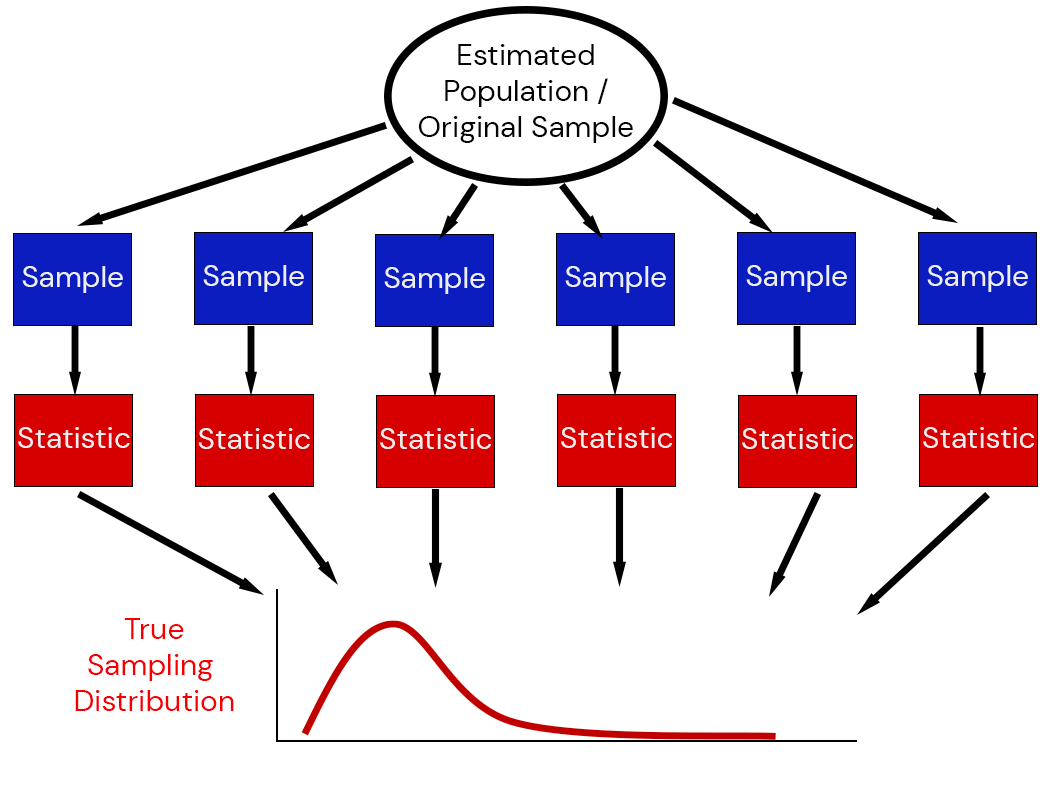
Statistics of Random Variables are Random Variables

The sum or mean of a random sample is itself a random variable:

\[\bar{X}_n = \frac{1}{n}\sum_{i=1}^n X_i \sim \mathcal{D}_n\]

\(\mathcal{D}_n\): The sampling distribution of the mean (or sum, or other estimate of interest).

Sampling Distributions

Illustration of the Sampling Distribution

Likelihood

Likelihood

How do we “fit” distributions to a dataset?

Likelihood of data to have come from distribution \(\mathcal{D}\) with pdf \(f(\mathbf{x} | \theta)\):

\[\mathcal{L}(\theta | \mathbf{x}) = \underbrace{f(\mathbf{x} | \theta)}_{\text{PDF}}\]

In other words: likelihood evaluates parameters conditional on data, PDF evaluates data conditional on parameters.

Normal Distribution PDF

\[f_\mathcal{D}(x) = p(x | \mu, \sigma) = \frac{1}{\sigma\sqrt{2\pi}} \exp\left(-\frac{1}{2}\left(\frac{x - \mu}{\sigma}^2\right)\right)\]

Figure 3

Likelihood of Multiple Samples

For multiple (independent) samples \(\mathbf{x} = \{x_1, \ldots, x_n\}\):

\[\mathcal{L}(\theta | \mathbf{x}) = \prod_{i=1}^n \mathcal{L}(\theta | x_i).\]

Likelihood Example

Distribution Likelihood
\(N(0, 1)\) 3.7e-11

Likelihood Example

Distribution Likelihood
\(N(0, 1)\) 3.7e-11
\(N(-1, 2)\) 5.9e-10

Likelihood Example

Distribution Likelihood
\(N(0, 1)\) 3.7e-11
\(N(-1, 2)\) 5.9e-10
\(N(-1, 1)\) 1.2e-13

Log-Likelihood

Likelihoods get very small very fast due to multiplying small numbers.

This is a computational problem due to underflow.

We use logarithms to avoid these issues: compute \(\log \mathcal{L}(\theta | x)\).
Logarithms for probability calculations

Upcoming Schedule

Next Classes

Next Week: Exploratory Data Analysis

Assessments

Homework 1 due next Friday (2/6).

Reading:

References

References (Scroll for Full List)

Walker, W. E., Harremoës, P., Rotmans, J., Sluijs, J. P. van der, Asselt, M. B. A. van, Janssen, P., & Krayer von Krauss, M. P. (2003). Defining uncertainty: A conceptual basis for uncertainty management in model-based decision support. Integrated Assessment, 4, 5–17. https://doi.org/10.1076/iaij.4.1.5.16466