Bias, Variance, and Overfitting
Lecture 17
March 4, 2026
Impact of Increasing Model Complexity

Figure 1: True data and the data-generating curve.
Impact of Increasing Model Complexity
Code
function polyfit(d, x, y)
    function m(d, θ, x)
        mout = zeros(length(x), d + 1)
        for j in eachindex(x)
            for i = 0:d
                mout[j, i + 1] = θ[i + 1] * x[j]^i
            end
        end
        return sum(mout; dims=2)
    end
    θ₀ = [zeros(d+1); 1.0]
    lb = [-10.0 .+ zeros(d+1); 0.01]
    ub = [10.0 .+ zeros(d+1); 20.0]
    optim_out = optimize(θ -> -sum(logpdf.(Normal.(m(d, θ[1:end-1], x), θ[end]), y)), lb, ub, θ₀)
    θmin = optim_out.minimizer
    mfit(x) = sum([θmin[i + 1] * x^i for i in 0:d])
    return (mfit, θmin[end])
end

function plot_polyfit(d, x, y)
    m, σ = polyfit(d, x, y)
    p = scatter(x, y, label="Data", markersize=5, ylabel=L"$y$", xlabel=L"$x$", title="Degree $d")
    plot!(p, xrange, m.(xrange), ribbon = 1.96 * σ, fillalpha=0.2, lw=3, label="Fit")
    ylims!(p, (-30, 15))
    plot!(p, size=(600, 450))
    return p
end

p1 = plot_polyfit(1, x, y)
p2 = plot_polyfit(2, x, y)

display(p1)
display(p2)

Impact of Increasing Model Complexity


Impact of Increasing Model Complexity


Implications of Model DOF
Higher DOF ⇒ more ability to represent complex patterns.
If DOF is too low, the model can’t capture meaningful data-generating signals (underfitting).
Implications of Model DOF
Higher DOF ⇒ more ability to represent complex patterns.
But if DOF is too high, the model will “learn” the noise rather than the signal, resulting in poor generalization (overfitting).
In- Vs. Out-Of-Sample Error
Code
ntest = 20
xtest = rand(Uniform(-2, 2), ntest)
ytest = f(xtest) + rand(Normal(0, 2), length(xtest))

in_error = zeros(11)
out_error = zeros(11)
#calculate sum of squared errors
for d = 0:10
    m, σ = polyfit(d, x, y)
    in_error[d+1] = sum((m.(x) .- y).^2)
    out_error[d+1] = sum((m.(xtest) .- ytest).^2)
end

plot(0:10, in_error / length(y), marker=(:circle, :blue, 8), line=(:blue, 3), label="In-Sample Error", xlabel="Polynomial Degree", ylabel="Mean Squared Error", legend=:topleft)
plot!(0:10, out_error / length(y), marker=(:circle, :red, 8), line=(:red, 3), label="Out-of-Sample Error")
plot!(yaxis=:log)
plot!(xticks=0:1:10)
Figure 7: Impact of increasing model complexity on in and out of sample error
Why Is Overfitting A Problem?
Example from The Signal and the Noise by Nate Silver:
- Fukishima engineers used a nonlinear model which predicted a >9 MW earthquake had a 13,000-year RP
- Nuclear plant was designed to withstand an 8.6 MW earthquake.
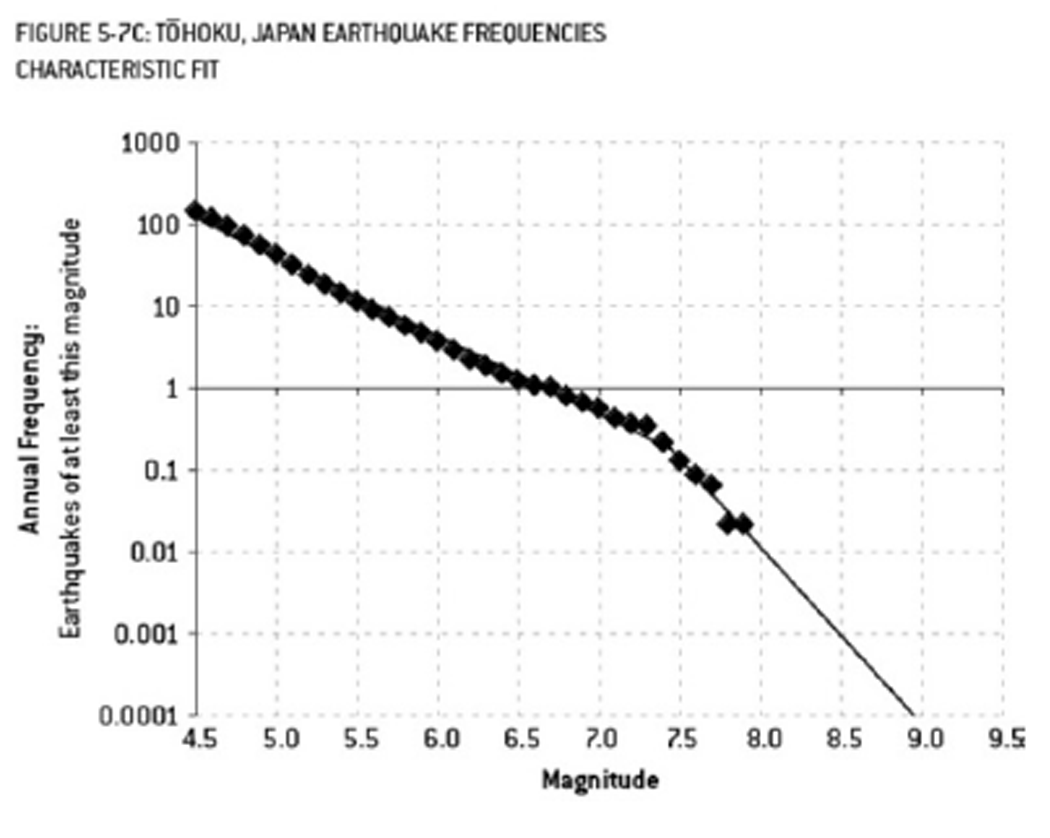
Why Is Overfitting a Problem
Example from The Signal and the Noise by Nate Silver:
- Theoretical linear relationship suggests that a >9 MW earthquake has a RP of 300 years.
- Using this model would have designed the plant to survive the 2011 9.1 MW earthquake.
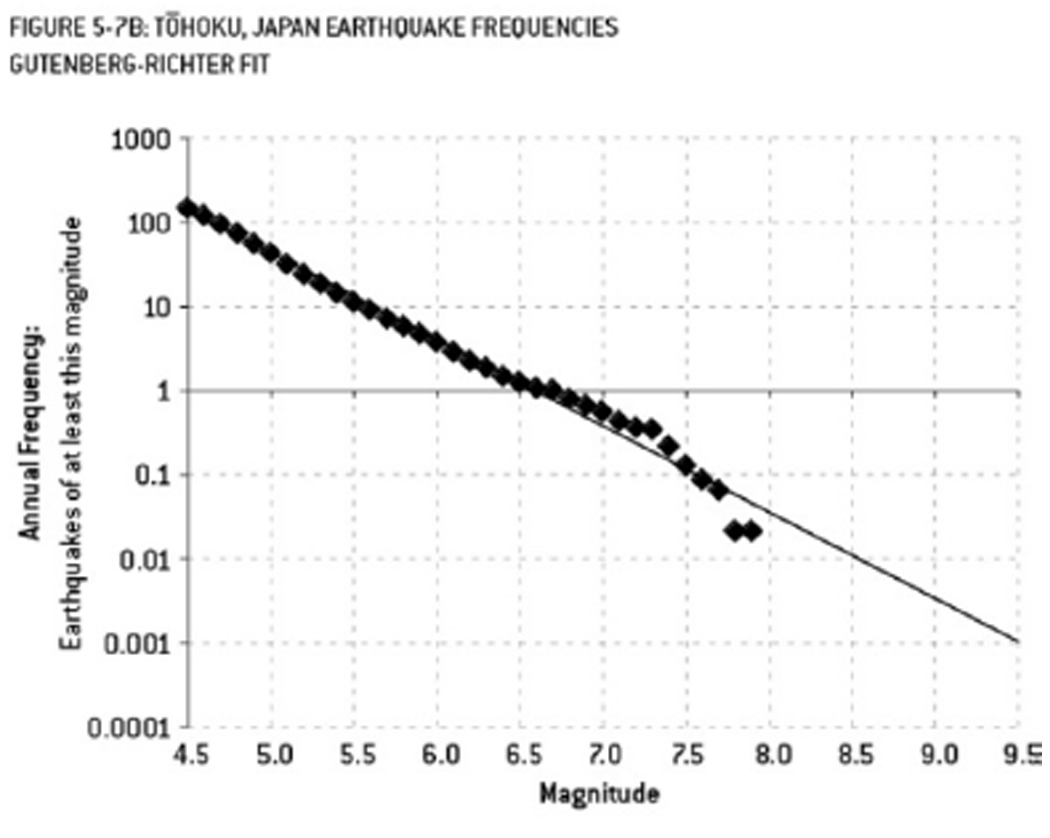
Common Story: Complexity and Bias-Variance

Source: Wikipedia