Monte Carlo Examples


Lecture 26

March 27, 2026

Review

Monte Carlo

  • Stochastic simulation: propagate random variables \(X\) through model \(f\) and want to estimate \(\mathbb{E}[f(X)] \approx \sum_{i=1}^n f(X_i)\) using samples \(X_1, \ldots, X_n\).
  • Example: probability of a standard Gaussian between \([0.8, 0.9]\): draw \(X_1, \ldots, X_n \sim N(0, 1)\), \[f(x) = \mathbb{I}_{[0.8, 0.9]}(x).\]

Statistics of Monte Carlo

  • Denote \(Y = f(X)\), \(\mathbb{E}[Y] = \mu\), and \(\sum_{i=1}^n Y_i = \tilde{\mu}_n\).
  • MC is unbiased: \(\mathbb{E}[\tilde{\mu}_n] = \mu\);
  • Monte Carlo standard error (MCSE): \(Y_i\) i.i.d., then \(\text{SE}(\tilde{\mu}_n) = \sigma_Y / \sqrt{n}\).

Monte Carlo Confidence Intervals

The \(\alpha\)-confidence interval is: \[\tilde{\mu}_n \pm \Phi^{-1}\left(1 - \frac{\alpha}{2}\right) \frac{\sigma_Y}{\sqrt{n}}\]

For example, the 95% confidence interval is \[\tilde{\mu}_n \pm 1.96 \frac{\sigma_Y}{\sqrt{n}}.\]

How Many Samples Do I Need?

Try:

  1. Run a “pilot” MC with a relatively small number of samples to estimate \(\mathbb{V}\left[Y_i\right]\).
  2. Pick a target MCSE \(\varepsilon\), then we need \(N \approx \mathbb{V}\left[Y_i\right] / \varepsilon^2\) samples.
  3. Run the “real” MC with sample size \(N\) and check if the MCSE is right (\(N\) might be off due to error in the variance estimate).
  4. If not, run more.

Airshed Modeling

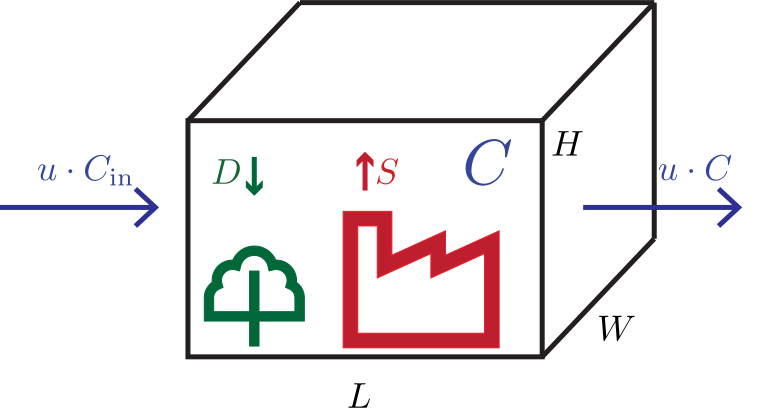
Airshed Model

Figure 1: Illustration of the airshed, including notation.

Goal: Find the probability of exceeding the 1-hour SO2 average exposure concentration standard, which is 0.14 ppm.

\[\mathbb{P}[\text{SO}_2(\theta) > 0.14] = \int \mathbb{I}(\text{SO}_2(\theta) > 0.14) p(\theta) d\theta\]

Airshed Model

Figure 2: Illustration of the airshed, including notation.

\[\frac{dC}{dt} = \frac{u}{L} C_\text{in} + \frac{S-D}{WHL} - \left(\frac{u}{L} + k\right)C\]

Forward Euler Discretization

\[ \frac{dC}{dt} = \frac{u}{L} C_\text{in}(t) + \frac{S-D}{WHL} - \left(\frac{u}{L} + k\right)C\]

\[\Rightarrow \frac{C(t+1) - C(t)}{\Delta t} = \frac{u}{L} C_\text{in}(t) + \frac{R}{WHL} - \left(\frac{u}{L} + k\right)C(t)\]

\[\bbox[yellow, 10px, border:5px solid red]{C(t+1) = \left(1 - \Delta t\left(\frac{u}{L} + k\right)\right)C(t) + \Delta t \left(\frac{u}{L} C_\text{in}(t) + \frac{R}{WHL}\right)} \]

Monte Carlo Samples

Code
nsamp = 1000
u = rand(LogNormal(log(2), 1), nsamp)
Cin = rand(LogNormal(log(0.16), 0.12), nsamp)
R = rand(Normal(0.5, 0.5), nsamp)

p1 = histogram(u, ylabel="count", xlabel=L"$u$ (m/s)", label=false,  size=(400, 450))
p2 = histogram(Cin, ylabel="count", xlabel=L"$C_{in}$ (ppm)", label=false, size=(400, 450))
p3 = histogram(R, ylabel="count", xlabel=L"$R$ (ppm/hr)", label=false,  size=(400, 450))
display(p1)
display(p2)
display(p3)
(a) Monte Carlo samples for the airshed model.
(b)
(c)
Figure 3

Simulation Results: Pilot Run

Code
# other parameters
C₀ = 0.07
T = 60
k = 0.3
W = 4
H = 5
L = 4
# conduct simulation
P = u / L .* Cin
l = u / L .+ k
C2 = zeros(T*100 + 1, nsamp)
S = 0:0.01:T
for (i, t) in pairs(S)
    if i == 1
        C2[i, :] .= C₀
    else
        C2[i, :] = (1 .- 0.01*l) .* C2[i-1, :] .+ 0.01 * P .+ 0.01 * R / (H * W * L)
    end
end
mean_SO2 = map(mean, eachcol(C2)) # calculate means
# plot histogram
p1 = histogram(mean_SO2, xlabel="1-Hour Average Exposure (ppm)", ylabel="Count", legend=false, tickfontsize=16, guidefontsize=18)
vline!(p1, [0.14], color=:red, linestyle=:dash, linewidth=3)
xticks!(p1, 0:0.04:0.3)
xaxis!(p1, xminorticks=2)
plot!(p1, size=(600, 450))
# plot cdf
p2 = plot(sort(mean_SO2), (1:nsamp) ./ nsamp, xlabel="1-Hour Average Exposure (ppm)", ylabel="Cumulative Probability", legend=false, linewidth=3)
vline!(p2, [0.14], linestyle=:dash, color=:red, linewidth=3, minorgrid=true)
xticks!(p2, 0:0.04:0.3)
xaxis!(p2, xminorticks=2)
yaxis!(p2, yminorticks=5)
plot!(p2, size=(600, 450))

display(p1)
display(p2)
(a) Monte Carlo samples for the airshed model.
(b)
Figure 4

What Sample Size?

Code
# show Monte Carlo estimate stabilization
avg_mc_out = zeros(nsamp)
avg_mc_out[1] = mean_SO2[1] > 0.14
std_mc_out = zeros(nsamp)
std_mc_out[1] = 0
for i = 2:nsamp
    avg_mc_out[i] = (avg_mc_out[i-1] * (i-1) + (mean_SO2[i] > 0.14)) / i
    std_mc_out[i] = 1/sqrt(i) * std(mean_SO2[1:i] .> 0.14)
end
p = plot(avg_mc_out, xlabel="Monte Carlo Iteration", ylabel="Probability", left_margin=3mm, legend=:false, ribbon=1.96*std_mc_out, fillalpha=0.3, linewidth=2, fillcolor=:red, right_margin=5mm, minorgrid=true)
ylims!(p, (0, 0.3))
yaxis!(p, yminorticks=5)
plot!(p, size=(600, 450))
display(p)
Figure 5: Monte Carlo estimation for the airshed model.

\(\hat{\sigma}_n^2 = \mathbb{V}\left[\mathbb{I}[x_{1:n} > 0.14]\right]\)

\(\hat{\sigma}_n^2 =\) 0.13

If we want to get the MCSE less than 0.01, then we need \(N \approx \tilde{\sigma}_n * 10,000\) samples.

Monte Carlo Estimation: Full Run

Let’s round up and use 20,000 samples.

Code
# show Monte Carlo estimate stabilization
# get new samples
nsamp = 20_000
u = rand(LogNormal(log(2), 1), nsamp)
Cin = rand(LogNormal(log(0.16), 0.12), nsamp)
R = rand(Normal(0.5, 0.5), nsamp)
# conduct simulation
P = u / L .* Cin
l = u / L .+ k
C2 = zeros(T*100 + 1, nsamp)
S = 0:0.01:T
for (i, t) in pairs(S)
    if i == 1
        C2[i, :] .= C₀
    else
        C2[i, :] = (1 .- 0.01*l) .* C2[i-1, :] .+ 0.01 * P .+ 0.01 * R / (H * W * L)
    end
end
mean_SO2 = map(mean, eachcol(C2)) # calculate means

# compute MC Estimate
avg_mc_out = zeros(nsamp)
avg_mc_out[1] = mean_SO2[1] > 0.14
std_mc_out = zeros(nsamp)
std_mc_out[1] = 0
for i = 2:nsamp
    avg_mc_out[i] = (avg_mc_out[i-1] * (i-1) + (mean_SO2[i] > 0.14)) / i
    std_mc_out[i] = 1/sqrt(i) * std(mean_SO2[1:i] .> 0.14)
end
p = plot(avg_mc_out, xlabel="Monte Carlo Iteration", ylabel="Probability", left_margin=3mm, legend=:false, ribbon=1.96*std_mc_out, fillalpha=0.3, linewidth=2, fillcolor=:red, right_margin=5mm, minorgrid=true)
ylims!(p, (0.1, 0.2))
yaxis!(p, yminorticks=5)
plot!(p, size=(600, 450))
display(p)
Figure 6: Monte Carlo estimation for the airshed model.

MCSE: 0.002

Estimate: 0.13 \(\pm\) 0.005

Flood Modeling

Annual Expected Damages

Suppose we have a client who wants us to advise them on their expected flood losses from a nearby stream. The house is worth $400,000 and floods when stream water levels exceed 1.5m.

Code
# load data
true_dist = GeneralizedExtremeValue(0.9, 0.5, 0.16)
depths = rand(true_dist, 40)
# fit GEV distribution
gev_loglik(y, θ) = sum(logpdf.(GeneralizedExtremeValue(θ[1], θ[2], θ[3]), y))
p0 = [0.1, 2.0, 0.0]
lb = [0.0, 0.01, -1.0]
ub = [2.0, 5.0, 1.0]
mle_out = optimize(p -> -gev_loglik(depths, p), lb, ub, p0)
θ_mle = mle_out.minimizer
wl_dist = GeneralizedExtremeValue(θ_mle[1], θ_mle[2], θ_mle[3])

p1 = histogram(depths, legend=false, xlabel="Stream Depth (m)", ylabel="Density", normalize=:pdf, color=:gray)
plot!(p1, wl_dist, color=:red, linewidth=3, normalize=:pdf)
plot!(p1, xlims=(0, 5))
plot!(p1, size=(500, 450))
Figure 7: Record of stream water levels

Depth-Damage Functions

Translating flood depths to damages requires a depth-damage function. For this problem:

\[d(h) = \mathbb{I}[h > 0] \frac{1}{1+\exp(-k(x-x_0))},\]

where \(k=1.25\) and \(x_0=2\).

Code
h = 0:0.01:5
dd(h, k, x₀) = (h .> 0) * 1 ./ (1 .+ exp.(-k * (h .- x₀)))
plot(h, dd(h, 1.25, 2), xlabel="Flood Depth (m)", ylabel="Fraction of Value Damaged", legend=false)
ylims!(0, 1)
plot!(size=(500, 450))
Figure 8: Depth-damage function

Estimating Expected Annual Damages

We want to estimate \(\mathbb{E}[d(H)]\), \(H + 1.5 \sim \text{GEV}(\mu, \sigma, \xi)\).

How many MC samples do we need? Pilot with 1,000 samples:

Figure 9: Histogram of initial depth-damage functions

\(\tilde{\sigma}_n^2 =\) 6.7e8

If we want to get the MCSE less than $100, then we need \(N \approx \tilde{\sigma}_n / 10,000\) samples.

Monte Carlo Estimate

Let’s round up and use 100,000 samples:

Figure 10: Monte Carlo convergence

MCSE: 82.0

Estimate: 11157.0 \(\pm\) 160.0

Extensions to Optimization

Stochastic Optimization

Problems typically have the form \[\min_{a \in \mathcal{A}} \mathbb{E}_X[f(X; a]\] where

  • \(\mathcal{A}\) is a set of decision alternatives;
  • \(f(x; a)\) is the objective function with random realization \(x\) and action \(a\).

There may also be some constraints on what actions are allowable.

Example: Home Elevation

Let’s extend the previous example. Suppose our client now wants us to recommend how high they should elevate their house to minimize flooding damages.

  • \(a \in \mathcal{A}\) are elevation heights;
  • \(f(x; a)\) is the net cost of elevating with height \(a\) and water level realizations \(x\): \[f(x; a) = \underbrace{D(x; a)}_{\text{flood damages}} + \underbrace{C(a)}_{\text{investment cost}}\]

Some Notes

  • Infrastructure investment problems typically have a design horizon: a period of time over which they are designed to be effective. Let’s use 30 years here.
  • \(X\) is no longer water levels from a single year, as before, but stochastic sequences of 30-year water levels.

Some Notes

  • Due to the time value of money, we need to discount future benefits with some discount rate \(\gamma\) to calculate the net present value (NPV) of benefits: \[NPV = \sum_{t=0}^T x_t (1-\gamma)^t.\]
  • Cost function: \(C(\Delta h) = \mathbb{I}[h > 0](C_0 + C_1\Delta h)\).

Upcoming Schedule

Next Classes

Next Week: Spring Break

After That: The Bootstrap and Sampling Uncertainty

References

References (Scroll for Full List)