The Bootstrap


Lecture 28

April 8, 2026

Review

Implications of Sampling Variability

  • The data is one realization of a stochastic process.
  • Estimates of statistical quantities (parameters, test statistics, etc) depend on the data.
  • If we were to “re-run the tape”, we would get different data, and therefore different estimates.

How To Quantify Sampling Variability

  1. Standard errors: how much would we expect this quantity to vary from one data replication to another?
  2. Confidence intervals: what are the parameters that might have been expected to produce this data with some pre-assigned probability?

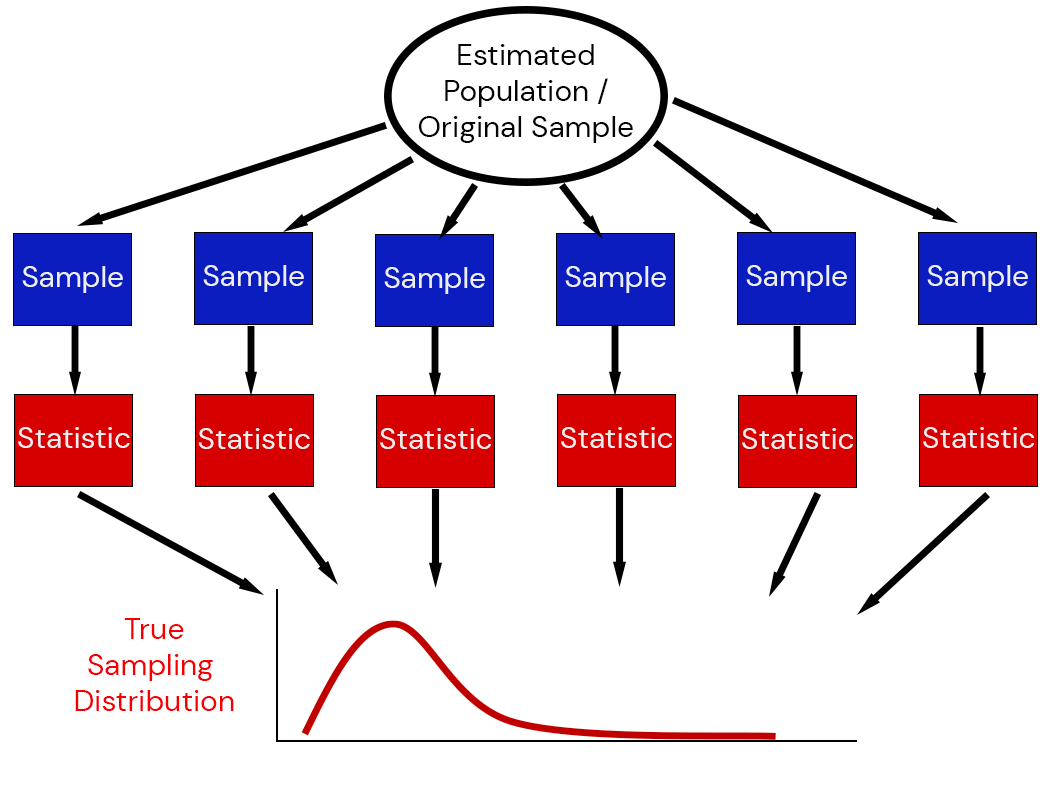
But for both of these, we need to know the sampling distribution: the underlying distribution of estimates across different data replications.

Sampling Distributions

The sampling distribution of a statistic captures the uncertainty associated with random samples.
Sampling Distribution

Estimating Sampling Distributions

  • Special Cases: can derive closed-form representations of sampling distributions (think statistical tests)
  • Asymptotics: Central Limit Theorem or Fisher Information

“Classical” Sampling Distributions

This means we need:

  1. Data that has a special form (e.g. linear regression with Gaussian noise) or can be transformed into that form (which has other problems);
  2. Recover Gaussian theory asymptotically as \(n \to \infty\) via CLT, but this may not hold well for any finite \(n\) and we don’t know how large \(n\) has to be.

The Bootstrap

The Bootstrap Principle

Efron (1979) suggested combining estimation with simulation: the bootstrap.

Key idea: use the data to simulate a data-generating mechanism.

Xxibit Bootstrap Meme

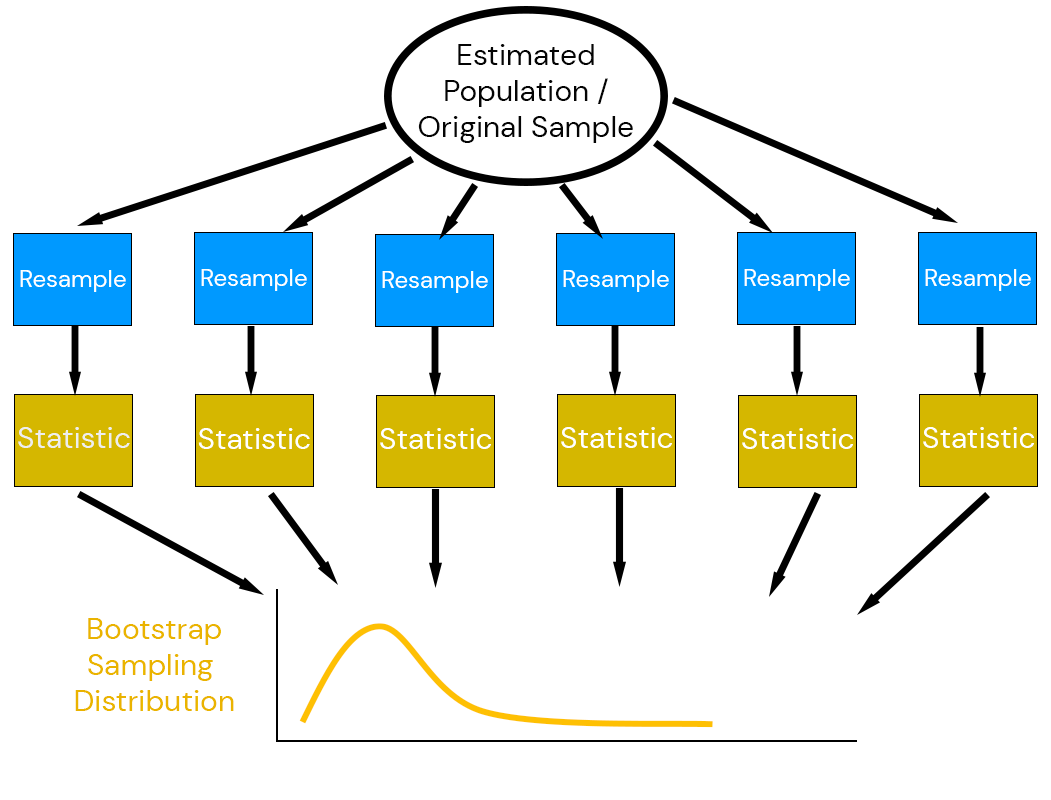
Bootstrap Principle

  • Assume the existing data is representative of the “true” population,
  • Simulate based on properties of the data itself
  • Re-estimate statistics from re-samples.

Bootstrap Sampling Distribution

Why Does The Bootstrap Work?

Efron’s key insight: due to the Central Limit Theorem, the bootstrap distribution \(\mathcal{D}(\tilde{t}_i)\) has the same relationship to the observed estimate \(\hat{t}\) as the sampling distribution \(\mathcal{D}(\hat{t})\) has to the “true” value \(t_0\):

\[\mathcal{D}(\tilde{t} - \hat{t}) \approx \mathcal{D}(\hat{t} - t_0)\]

where \(t_0\) the “true” value of a statistic, \(\hat{t}\) the sample estimate, and \((\tilde{t}_i)\) the bootstrap estimates.

The Fundamental Principle of Bootstrapping

In other words:

The population is to the sample what the sample is to the bootstrap samples.

What Can We Do With The Bootstrap?

Let \(t_0\) the “true” value of a statistic, \(\hat{t}\) the estimate of the statistic from the sample, and \((\tilde{t}_i)\) the bootstrap estimates.

  • Estimate Variance: \(\text{Var}[\hat{t}] \approx \text{Var}[\tilde{t}]\)
  • Bias Correction: \(\mathbb{E}[\hat{t}] - t_0 \approx \mathbb{E}[\tilde{t}] - \hat{t}\)

Notice that bias correction “shifts” away from the bootstrapped samples.

Bootstrap Confidence Intervals

Suppose we want to construct a \(1-\alpha\)% CI for \(t_0\). The most naive application of the bootstrap principle suggests that with \(1-\alpha\)% probability, then \(t_0\) falls inbetween \(Q_{\tilde{t}}(\alpha/2)\) and \(Q_{\tilde{t}}(1-\alpha/2))\).

Therefore, if the distribution for \(\tilde{t}\) approximates the sampling distribution of \(\hat{t}\), we get the:

Percentile Bootstrap CI: \[(Q_{\tilde{t}}(\alpha/2), Q_{\tilde{t}}(1-\alpha/2))\]

Bootstrap Confidence Intervals

The assumption that \(\mathcal{D}(\tilde{t}) \approx \mathcal{D}(\hat{t})\) is pretty strong and generally not satisfied! Instead, suppose it’s only the variability in the samples that we assume is similar, e.g. \[\mathcal{D}(\tilde{t} - \hat{t}) \approx \mathcal{D}(\hat{t} - t_0)\].

Bootstrap Confidence Intervals

Then:

\[\begin{aligned} 1 - \alpha &= \mathbb{P}\left[Q_{\tilde{t}}(\alpha/2) \leq \tilde{t} \leq Q_{\tilde{t}}(1 - \alpha/2) \right] \\ &= \mathbb{P}\left[Q_{\tilde{t}}(\alpha/2) - \hat{t} \leq \tilde{t} - \hat{t} \leq Q_{\tilde{t}}(1 - \alpha/2) - \hat{t} \right] \\ &= \mathbb{P}\left[\hat{t} - Q_{\tilde{t}}(\alpha/2) \geq \color{red}{\hat{t} - \tilde{t}} \geq \hat{t} - Q_{\tilde{t}}(1 - \alpha/2) \right] \\ &\approx \mathbb{P}\left[\hat{t} - Q_{\tilde{t}}(\alpha/2) \geq \color{red}{t_0 - \hat{t}} \geq \hat{t} - Q_{\tilde{t}}(1 - \alpha/2) \right] \\ &= \mathbb{P}\left[2\hat{t} - Q_{\tilde{t}}(\alpha/2) \geq t_0 \geq 2\hat{t} - Q_{\tilde{t}}(1 - \alpha/2) \right] \end{aligned}\]

Bootstrap Confidence Intervals

This gives us the:

Basic Bootstrap CI: \(\left(2\hat{t} - Q_{\tilde{t}}(1-\alpha/2), 2\hat{t} - Q_{\tilde{t}}(\alpha/2)\right)\)

Why Can The Percentile CI Go Wrong?

Suppose there is a bias \(\mathbb{E}\left[\tilde{t}\right] = \bar{t}^* = \hat{t} + B\) and let \[Q_{\tilde{t}}(0.05) = \bar{t}^* - \sigma_1\] and \[Q_{\tilde{t}}(0.95) = \bar{t}^* + \sigma_2.\]

Why Can The Percentile CI Go Wrong?

Then the 90% percentile CI is \[\left(\hat{t} + B - \sigma_1, \hat{t} + B + \sigma_2\right)\] while the 90% basic bootstrap CI is

\[\begin{aligned} &\left(2\hat{t} - \left(\bar{t}^* + \sigma_2\right), 2 \hat{t} - \left(\bar{t}^* - \sigma_1\right)\right) \\ &=\left(\hat{t} - B - \sigma_2, \hat{t} - B + \sigma_1\right). \end{aligned}\]

Why Can The Percentile CI Go Wrong?

In other words, the percentile CI will get the bias wrong and flip potential assymetries due to skew.

It can be reasonable if you know there is not much bias or skew, but this is hard to guarantee in practice: better to use the basic CI or more advanced CIs (next week).

The Non-Parametric Bootstrap

The Non-Parametric Bootstrap

The non-parametric bootstrap is the most “naive” approach to the bootstrap: resample-then-estimate.

Non-Parametric Bootstrap

Sources of Non-Parametric Bootstrap Error

  1. Sampling error: error from using finitely many replications
  2. Statistical error: error in the bootstrap sampling distribution approximation

Simple Example: Is A Coin Fair?

Suppose we have observed twenty flips with a coin, and want to know if it is weighted.

Code
# define coin-flip model
p_true = 0.6
n_flips = 20
coin_dist = Bernoulli(p_true)
# generate data set
dat = rand(coin_dist, n_flips)
freq_dat = sum(dat) / length(dat)
dat'
1×20 adjoint(::Vector{Bool}) with eltype Bool:
 1  1  0  0  0  1  0  0  0  1  1  1  1  1  1  0  1  1  1  1

The frequency of heads is 0.65.

Is The Coin Fair?

Code
# bootstrap: draw new samples
function coin_boot_sample(dat)
    boot_sample = sample(dat, length(dat); replace=true)
    return boot_sample
end

function coin_boot_freq(dat, nsamp)
    boot_freq = [sum(coin_boot_sample(dat)) for _ in 1:nsamp]
    return boot_freq / length(dat)
end

boot_out = coin_boot_freq(dat, 1000)
q_boot = 2 * freq_dat .- quantile(boot_out, [0.975, 0.025])

p = histogram(boot_out, xlabel="Heads Frequency", ylabel="Count", title="1000 Bootstrap Samples", label=false, right_margin=5mm)
vline!(p, [p_true], linewidth=3, color=:orange, linestyle=:dash, label="True Probability")
vline!(p, [mean(boot_out) ], linewidth=3, color=:red, linestyle=:dash, label="Bootstrap Mean")
vline!(p, [freq_dat], linewidth=3, color=:purple, linestyle=:dot, label="Observed Frequency")
vspan!(p, q_boot, linecolor=:grey, fillcolor=:grey, alpha=0.3, fillalpha=0.3, label="95% CI")
plot!(p, size=(1000, 450))

Figure 1: Bootstrap heads frequencies for 20 resamples.

Larger Sample Example

Code
n_flips = 50
dat = rand(coin_dist, n_flips)
freq_dat = sum(dat) / length(dat)

boot_out = coin_boot_freq(dat, 1000)
q_boot = 2 * freq_dat .- quantile(boot_out, [0.975, 0.025])

p = histogram(boot_out, xlabel="Heads Frequency", ylabel="Count", title="1000 Bootstrap Samples", titlefontsize=20, guidefontsize=18, tickfontsize=16, legendfontsize=16, label=false, bottom_margin=7mm, left_margin=5mm, right_margin=5mm)
vline!(p, [p_true], linewidth=3, color=:orange, linestyle=:dash, label="True Probability")
vline!(p, [mean(boot_out) ], linewidth=3, color=:red, linestyle=:dash, label="Bootstrap Mean")
vline!(p, [freq_dat], linewidth=3, color=:purple, linestyle=:dot, label="Observed Frequency")
vspan!(p, q_boot, linecolor=:grey, fillcolor=:grey, alpha=0.3, fillalpha=0.3, label="95% CI")
plot!(p, size=(1000, 450))

Figure 2: Bootstrap heads frequencies for 1000 resamples.

Why Use The Non-Parametric Bootstrap?

  • Do not need to rely on variance asymptotics;
  • Can obtain non-symmetric CIs.
  • Embarrassingly parallel to simulate new replicates and generate statistics.

When Can’t You Use The Non-Parametric Bootstrap

  • Maxima/minima
  • Very extreme values.

Generally, anything very sensitive to outliers which might not be re-sampled.

Key Points and Upcoming Schedule

Key Points

  • Bootstrap: Approximate sampling distribution by re-simulating data
  • Non-Parametric Bootstrap: Treat data as representative of population and re-sample.
  • More complicated for structured data: block bootstrap for time series, analogues for spatial data.

Sources of Non-Parametric Bootstrap Error

  1. Sampling error: error from using finitely many replications
  2. Statistical error: error in the bootstrap sampling distribution approximation

When To Use The Non-Parametric Bootstrap

  • Sample is representative of the sampling distribution
  • Doesn’t work well for extreme values!
  • Does not work at all for max/mins (or any other case where the CLT fails).

Next Classes

Friday: The Non-Parametric Bootstrap

Next Week: Parametric Bootstrap and Other Nuances

Assessments

Homework 5: Due next Friday (4/17)

Project Updates: Due Friday (4/10)

Quiz 3: Friday (4/10) through pre-break material on Monte Carlo.

References

References (Scroll for Full List)

Efron, B. (1979). Bootstrap methods: Another look at the jackknife. Ann. Stat., 7, 1–26. https://doi.org/10.1214/aos/1176344552