The Bootstrap for Structured Data


Lecture 29

April 10, 2026

Review

The Bootstrap Principle

Efron (1979) suggested combining estimation with simulation: the bootstrap.

Key idea: use the data to simulate a data-generating mechanism.

Xxibit Bootstrap Meme

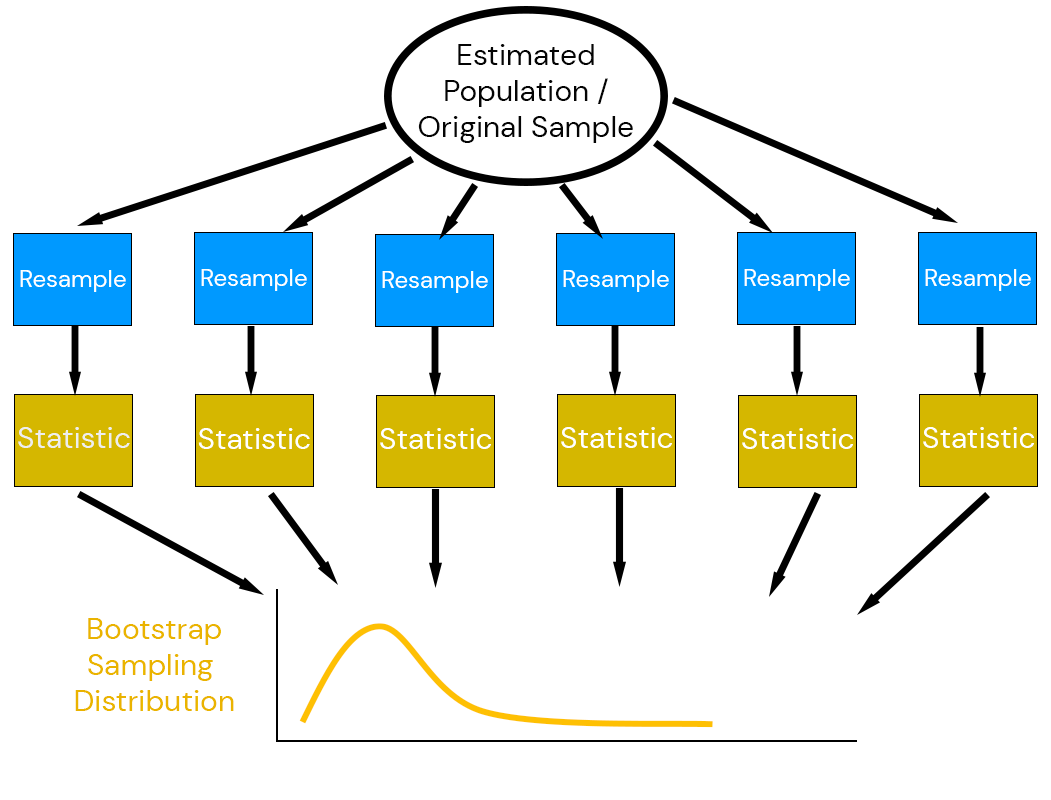
Bootstrap Principle

  • Assume the existing data is representative of the “true” population,
  • Simulate based on properties of the data itself
  • Re-estimate statistics from re-samples.

Bootstrap Sampling Distribution

The Fundamental Principle of Bootstrapping

In other words:

The population is to the sample what the sample is to the bootstrap samples.

What Can We Do With The Bootstrap?

Let \(t_0\) the “true” value of a statistic, \(\hat{t}\) the estimate of the statistic from the sample, and \((\tilde{t}_i)\) the bootstrap estimates.

  • Estimate Variance: \(\text{Var}[\hat{t}] \approx \text{Var}[\tilde{t}]\)
  • Bias Correction: \(\mathbb{E}[\hat{t}] - t_0 \approx \mathbb{E}[\tilde{t}] - \hat{t}\)
  • Hypothesis Testing: Compute \(p\)-values using bootstrap sampling distribution

Notice that bias correction “shifts” away from the bootstrapped samples.

Bootstrap Confidence Intervals

Percentile Bootstrap CI: \[(Q_{\tilde{t}}(\alpha/2), Q_{\tilde{t}}(1-\alpha/2))\]

Basic Bootstrap CI: \(\left(2\hat{t} - Q_{\tilde{t}}(1-\alpha/2), 2\hat{t} - Q_{\tilde{t}}(\alpha/2)\right)\)

The Non-Parametric Bootstrap

The non-parametric bootstrap is the most “naive” approach to the bootstrap: resample-then-estimate.

Non-Parametric Bootstrap

Non-Parametric Bootstrap Algorithm

Have dataset of \(m\) points, want \(k\) replicates:

  1. Resample \(m\) points from data with replacement \(k\) times;
  2. Estimate statistic from each replicate.
  3. Compute mean, variance, CI, etc.

Sources of Non-Parametric Bootstrap Error

  1. Sampling error: error from using finitely many replications
  2. Statistical error: error in the bootstrap sampling distribution approximation

Bootstrapping with Structured Data

Simple Bootstrapping Fails with Structured Data

Code
tide_dat = CSV.read(joinpath("data", "surge", "norfolk-hourly-surge-2015.csv"), DataFrame)
surge_resids = tide_dat[:, 5] - tide_dat[:, 3]

p1 = plot(surge_resids, xlabel="Hour", ylabel="(m)", title="Tide Gauge Residuals", label=:false, linewidth=3)
plot!(p1, size=(600, 450))

resample_index = sample(1:length(surge_resids), length(surge_resids); replace=true)
p2 = plot(surge_resids[resample_index], xlabel="Hour", ylabel="(m)", title="Tide Gauge Resample", label=:false, linewidth=3)
plot!(p2, size=(600, 450))

display(p1)
display(p2)

(a) Simple bootstrap with time series data.
(b)
Figure 1

Block Bootstraps

Clever idea from Kunsch (1989): Divide time series \(y_{1:T}\) into overlapping blocks of length \(k\).

\[\{y_{1:k}, y_{2:k+1}, \ldots y_{n-k+1:n}\}\]

Then draw \(m = n / k\) of these blocks with replacement and construct replicate time series:

\[\hat{y}_{1:n} = (y_{b_1}, \ldots, y_{b_m}) \]

Note: Your series must not have a trend!

Block Bootstrap Example

Code
k = 20
n_blocks = length(surge_resids) - k + 1
blocks = zeros(Float64, (k, n_blocks))
for i = 1:n_blocks
    blocks[:, i] = surge_resids[i:(k+i-1)]
end
blocks[:, 1:5]
20×5 Matrix{Float64}:
  0.136   0.107   0.097   0.093   0.093
  0.107   0.097   0.093   0.093   0.08
  0.097   0.093   0.093   0.08    0.068
  0.093   0.093   0.08    0.068   0.031
  0.093   0.08    0.068   0.031   0.005
  0.08    0.068   0.031   0.005   0.011
  0.068   0.031   0.005   0.011   0.012
  0.031   0.005   0.011   0.012   0.001
  0.005   0.011   0.012   0.001  -0.002
  0.011   0.012   0.001  -0.002  -0.014
  0.012   0.001  -0.002  -0.014  -0.013
  0.001  -0.002  -0.014  -0.013  -0.015
 -0.002  -0.014  -0.013  -0.015  -0.02
 -0.014  -0.013  -0.015  -0.02   -0.019
 -0.013  -0.015  -0.02   -0.019  -0.031
 -0.015  -0.02   -0.019  -0.031  -0.071
 -0.02   -0.019  -0.031  -0.071  -0.067
 -0.019  -0.031  -0.071  -0.067  -0.084
 -0.031  -0.071  -0.067  -0.084  -0.086
 -0.071  -0.067  -0.084  -0.086  -0.092
Code
m = Int64(ceil(length(surge_resids) / k))
n_boot = 1_000
surge_bootstrap = zeros(length(surge_resids), n_boot)
for i = 1:n_boot
    block_sample_idx = sample(1:n_blocks, m; replace=true)
    surge_bootstrap[:, i] = reduce(vcat, blocks[:, block_sample_idx])
end

p = plot(surge_resids, color=:black, lw=3, label="Data", xlabel="Hour", ylabel="(m)", title="Tide Gauge Residuals", alpha=0.5)
plot!(p, surge_bootstrap[:, 1], color=:blue, lw=3, label="Replicate", alpha=0.5)
plot!(p, size=(600, 500))
Figure 2: Comparison of original data with block bootstrap replicate.

Block Bootstrap Replicates

Code
p = plot(xlabel="Hour", ylabel="(m)", title="Tide Gauge Residuals")
for i = 1:10
    label = i == 1 ? "Replicate" : false
    plot!(p, surge_bootstrap[:, i], label=label, color=:gray, alpha=0.2, lw=2)
end
plot!(p, surge_resids, label="Data", color=:black, lw=3)
plot!(p, size=(1200, 500))

Figure 3: Block bootstrap with time series data.

Generalizing the Block Bootstrap

  • Circular Bootstrap: “Wrap” the time series in a circle, \(y_1, y_2, \ldots, y_n, y_1, y_2, \ldots\) then divide into blocks and resample.
  • Stationary Bootstrap: Use random block lengths to avoid systematic boundary transitions.
  • Block of Blocks Bootstrap: Divide series into blocks of length \(k_2\), then subdivide into blocks of length \(k_1\). Sample blocks with replacement then sample sub-blocks within each block with replacement.

Key Points and Upcoming Schedule

Key Points

  • Bootstrap: Approximate sampling distribution by re-simulating data
  • Non-Parametric Bootstrap: Treat data as representative of population and re-sample.
  • More complicated for structured data: block bootstrap for time series, analogues for spatial data.

Sources of Non-Parametric Bootstrap Error

  1. Sampling error: error from using finitely many replications
  2. Statistical error: error in the bootstrap sampling distribution approximation

When To Use The Non-Parametric Bootstrap

  • Sample is representative of the sampling distribution
  • Doesn’t work well for extreme values!
  • Does not work at all for max/mins (or any other case where the CLT fails).

Next Classes

Next Week: Parametric Bootstrap and Other Nuances

Assessments

Homework 5: Due next Friday (4/17)

Project Updates: Due today (4/10)

References

References (Scroll for Full List)

Efron, B. (1979). Bootstrap methods: Another look at the jackknife. Ann. Stat., 7, 1–26. https://doi.org/10.1214/aos/1176344552
Kunsch, H. R. (1989). The jackknife and the bootstrap for general stationary observations. Ann. Stat., 17, 1217–1241. https://doi.org/10.1214/aos/1176347265